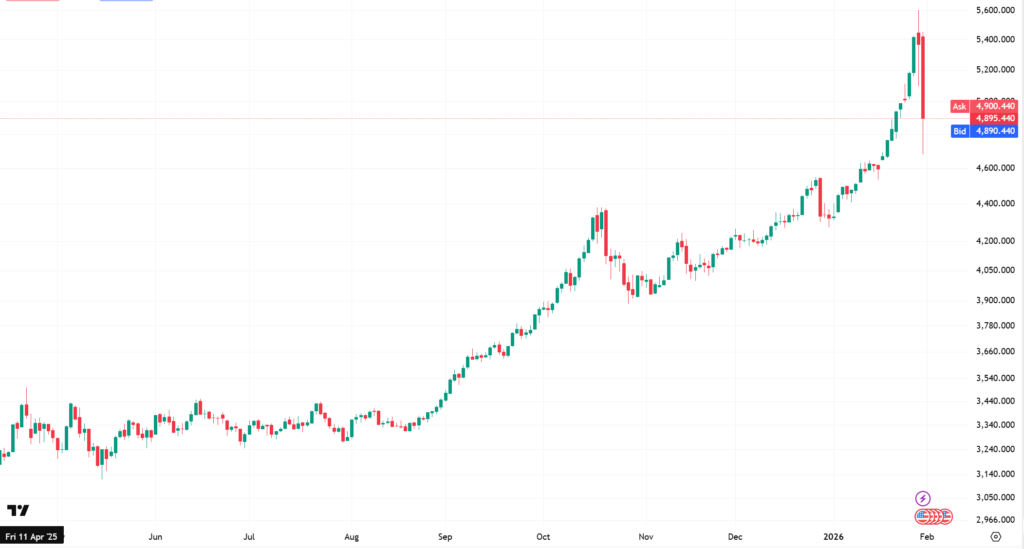
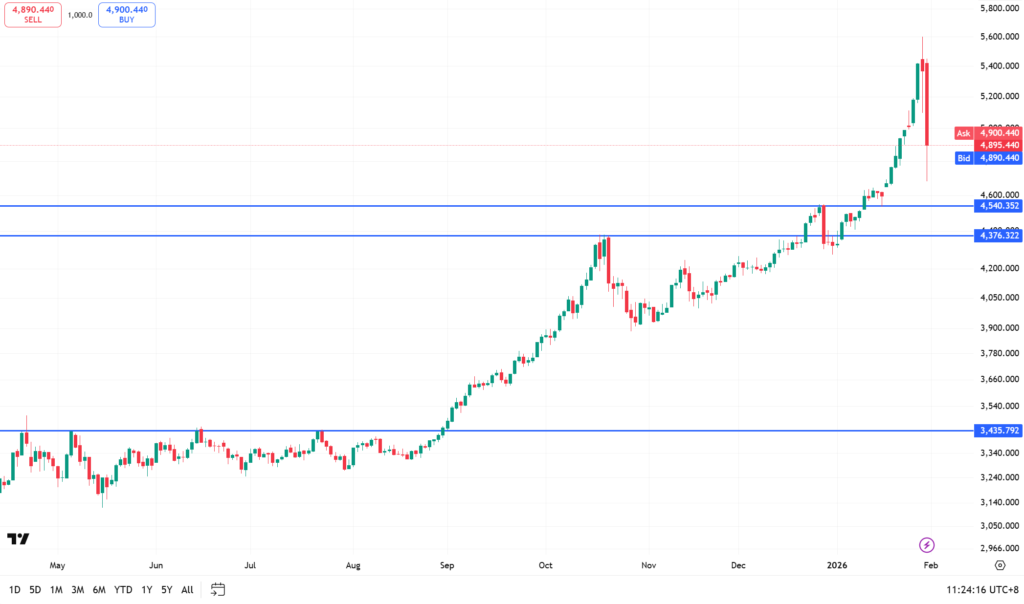
Gold had quietly gone over $5,600 on Thursday, though a correction inevitably occurred and the price fell below $4,900. However, the trend in gold has not been reversed.
This hard currency, the strongest in the history of human trade, has been incredibly strong these years. People once dismissed gold as a “non-interest-bearing asset not worth holding long-term”; however, its current performance presents a different narrative.
Investors are currently focused on three key questions:
- Why is gold rising so aggressively?
- Can it keep rising, or is this the peak?
- If gold is too expensive, are there other assets worth considering?
We will talk about these in this article.
1. Gold: The Unshakable Hard Currency
Karl Marx wrote in Capital that “Gold and silver are not by nature money, but money consists by its nature of gold and silver.” This classic quote perfectly explains the essence of precious metals. Humanity chose gold and silver as currency due to their scarcity, divisibility, and resistance to corrosion. Eventually, people found gold too heavy to carry and hard to use for small purchases, so they made paper money that was backed by the government’s credit.
However, national credit is still just credit. What happens when a nation loses its credibility?
Look at the yields on 10-year US Treasury notes. They have surged significantly.
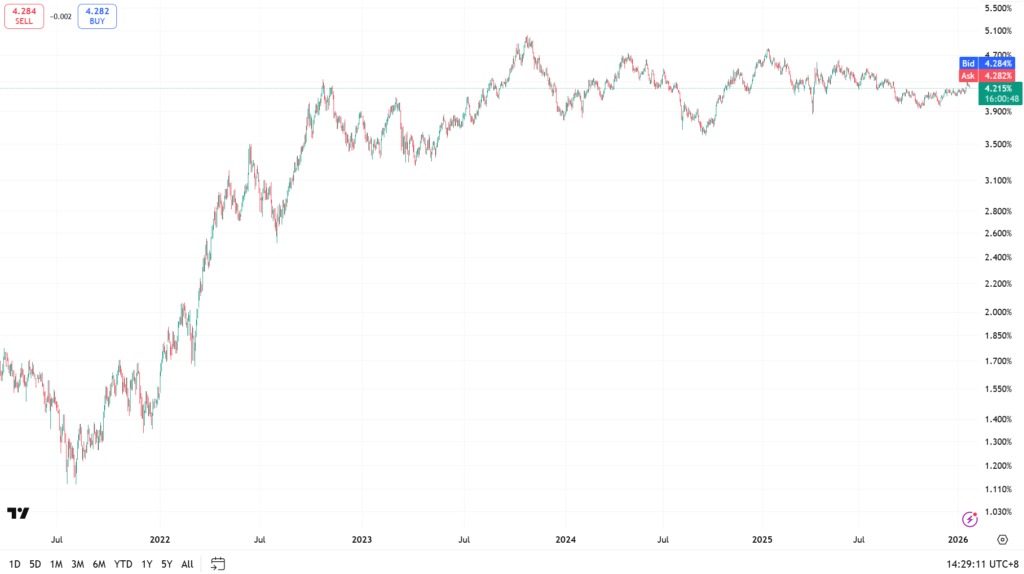
The market doesn’t want US government debt, so yields have to go up to attract investors. But why is that happening? In December 2025, the US government reported a monthly fiscal deficit of $145 billion, increased by 67%. The cumulative fiscal gap has reached $602 billion, or 6.4% of GDP. This is the second year in a row that it has been higher than 6%. The last time levels were this high was during World War II.
The US economy seems to be doing well, but the high level of debt suggests that there are hidden risks. The economy will suffer greatly if a debt crisis happens. Even if there isn’t a crisis, a simple economic downturn would make it difficult for the US government. When the next recession starts, it will take longer to recover because the government has already spent too much with very little room for fiscal policy.
The situation is dangerous, and investors are running away. If the most powerful country in the world is no longer reliable, who is?
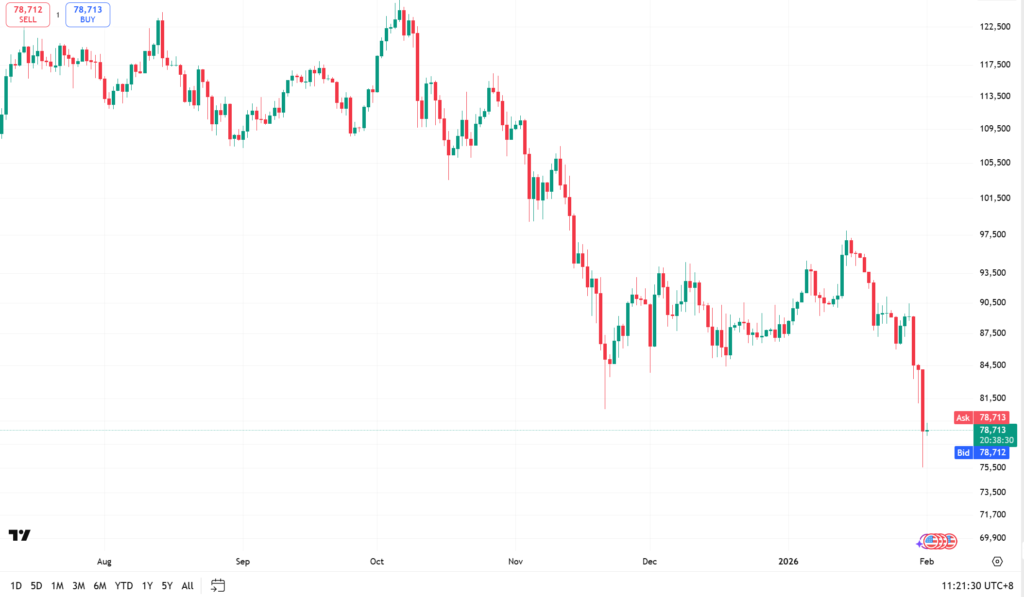
While looking for alternatives to fiat currency, Bitcoin, due to its limited supply, anonymity, and high circulation speed, has gained attention. People call Bitcoin “digital gold.” At one point, it rose to a high of $120,000, making it a fantastic investment.
But the celebration didn’t last long, and Bitcoin hasn’t taken the place of gold. Bitcoin has been going up and down around $80,000 since November 2024. It seems stuck. In 2025, amidst the ongoing Russia-Ukraine conflict and political unrest in Venezuela and Iran, Bitcoin acted like an outsider. Even though the US dollar debt crisis got worse, Bitcoin hasn’t become a safe-haven asset like gold.
2. The Asset Revaluation and the Challenge to the Dollar System
You should now understand why the price of gold is going up so quickly.
- Gold is an alternative to sovereign credit. When sovereign credit is in trouble, gold, which is “natural money,” becomes a safe place for money.
- Global conservatism has been a mainstream trend in recent years. As conflicts and global instability increase, there is a growing demand for safe havens.
- In the context of increasing US-China competition, China is intensifying its efforts to reduce reliance on the US dollar. This shift is disrupting the established dollar-dominated financial system. In fact, China has become the largest purchaser of gold.
In previous economic cycles, China acted as an industrial powerhouse, making foreign exchange through the export of goods. After that, China would reinvest its US dollars into American assets, such as treasuries, to support their prices. However, as the relationship shifted from cooperation to confrontation, China has stopped purchasing US debt and shifted its focus to gold. Therefore, it’s not surprising that treasury yields and gold prices are both going up.
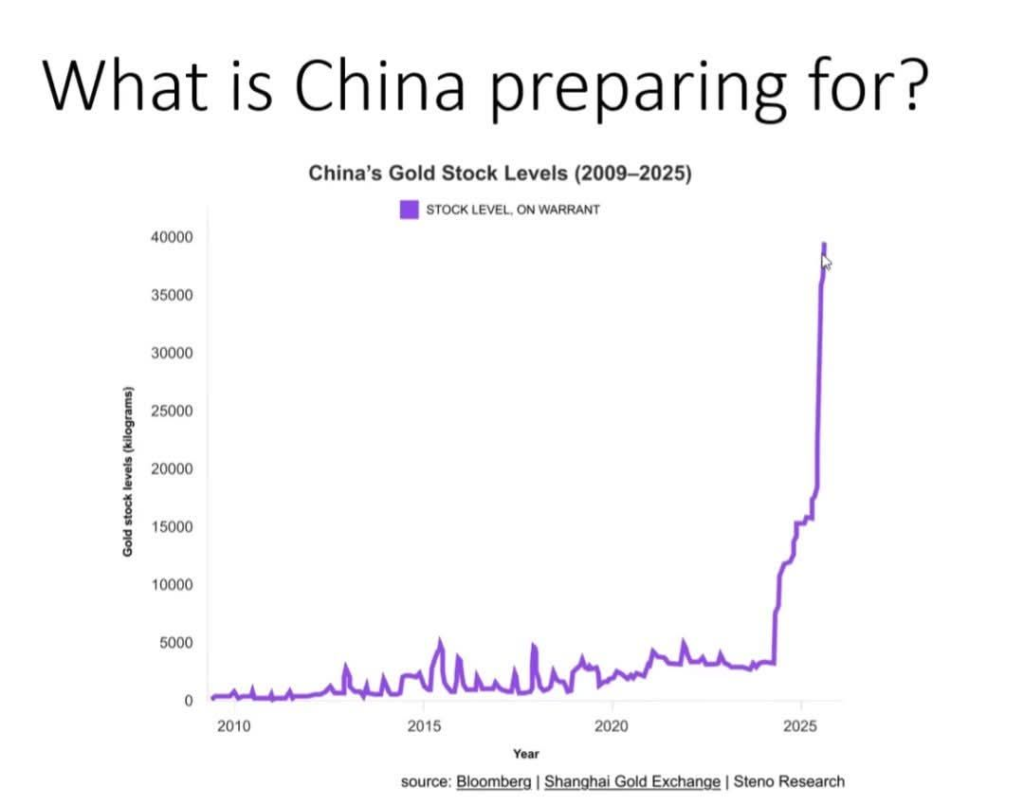
As the second-largest economy in the world, China has a massive influence on global asset prices. The crypto bull market essentially came to an end when China reiterated its ban on cryptocurrencies. The big buyer has left the table and moved to gold.
We can now answer the questions that investors mostly care about.
- Can gold keep rising?
- Is now the peak?
The logic behind the rise in gold remains intact. The world is still unstable, the US-China confrontation is still intensifying, China is still buying gold in bulk, and the US debt crisis is still unresolved. Furthermore, the Federal Reserve has started a rate-cutting cycle. A weak dollar usually means inflation and rising asset prices. It’s not surprising that some experts are saying the target price of gold should be $6,000.
But this doesn’t mean that gold won’t go through a correction.
A sudden acceleration in the late stages of a bull market is often caused by investors who missed the earlier rally. They were afraid to buy at $1,500, $2,000, or even $4,000. By the time it hit $5,000, they could no longer resist. They believe gold has broken through a new resistance level, and it is time to enter. They rush in, creating a vertical spike at the top of the chart. However, experienced traders know that this is a classic “overbought” signal. The last group of retail investors has come in, and those who bought early will now have a chance to sell. This causes selling pressure and leads to a price correction.
Note that the logic of the bull market has not changed, and the upward trend has not been broken. However, a sharp rise is always followed by selling pressure as profitable investors exit. The market will correct, but it will not necessarily turn bearish. Patient investors should wait for a better entry point.
There is support between $4,300 and $4,500, where gold is likely to stabilize. The next strong support level is around $3,400 if that one doesn’t hold.
3. Are there opportunities in other assets?
Although instability is a long-term trend, it does not mean you should sell everything for safe havens right now.
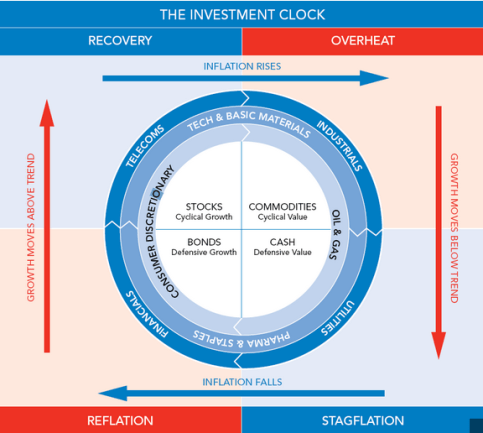
We need to figure out where we are in the economic cycle.
The US CPI dropped from 2.71% to 2.65% in December 2025. Inflation is now under control below 3%. In Q3 of 2025, US GDP grew at a rate of 2.3%, meaning that “stagflation,” which the market was worried about before, is not likely to happen.
You can be more optimistic. The US debt crisis is a worry, but the story of AI technology, along with expectations of a rate-cut cycle and strong GDP growth, suggests that a soft landing is likely. People may be too worried about a deep recession.
In the opinion of D Prime, there are two other assets that you can keep an eye on besides gold.
One is US stocks, which remain a long-term target for value investing. The Nasdaq 100 PE ratio is currently high at 35.18, but the US stock market remains strong. The market rally has persisted despite Trump’s comments about imposing taxes on Europe or deploying troops to Greenland.
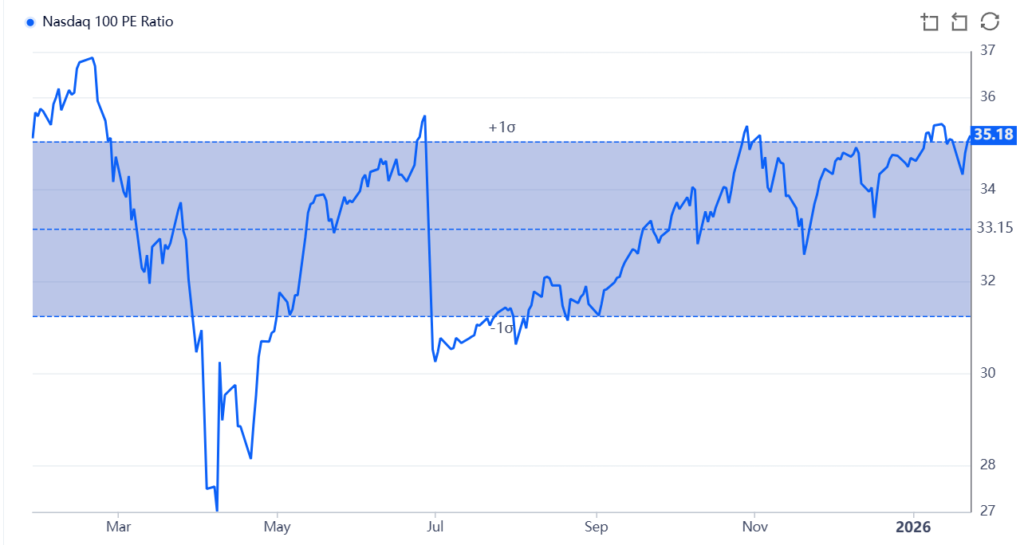
If the US economy shows signs of a recession, the stock market is likely to decline. But as we mentioned before, a soft landing is the most likely outcome. There is still a lot of room for monetary policy to take action, even though fiscal policy is not very flexible. Also, AI technologies are really making people more productive. It seems unlikely that there will be a severe depression.
If a recession does occur, stocks will offer a “buy the dip” opportunity. People should always have faith in value and the great companies that move humanity forward.
If you are truly concerned about a recession, think about purchasing US Treasuries. High yields mean that bond prices are at a low point. If the economy slows into a depression, bonds may be the best hedge against risk. Like stocks, worries about the debt crisis have made bond prices drop, but investors need to figure out for themselves if this is a “buy-the-dip opportunity” or just a trap.