You must have realized how important a trading system is by now. You might even be eager to open ChatGPT and ask it to write you code for a trading system that makes money every day.
But soon you’ll run into a new problem: no matter what kind of trading system you get, it has many problems when you run a backtest (don’t worry, I’ll show you how to do backtesting later).
Here is a Nasdaq H1 trading system I developed with AI. From 2021 to 2025, it made a total return of 174.49%, with a win rate of 44.86% and an R/R ratio of 1:2.37, but the process of making money was not always pleasant. You would have faced drawdowns during 2021.11–2022.9, 2023.1–2023.7, 2024.5–2024.10, and 2025.4–2025.9. Could you handle the fact that you would have suffered six months of decline if you had started trading this system in January 2023? Probably not. Even if you had enough patience, you would need to hold on until November 2023 before your balance returned to the starting level. That means you would have gone through a stagnation period of 10 months. It’s not uncommon for stagnation periods to last for up to three years. Could you keep going if you were in such a period?
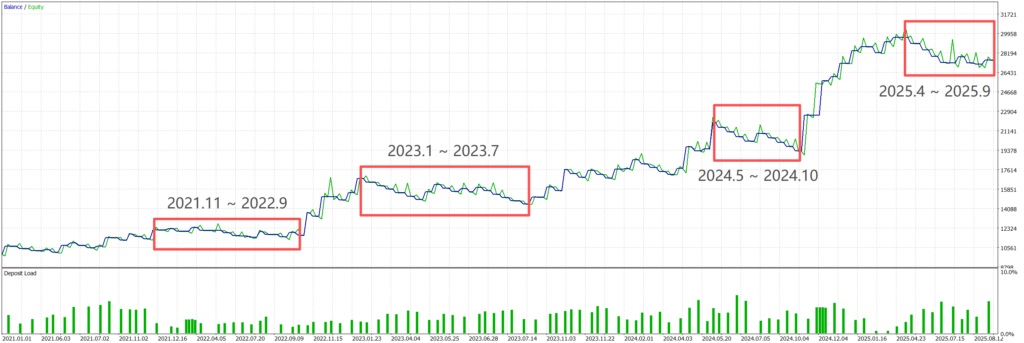
Don’t tell me you would persist. No, you wouldn’t, because you are human. There is no shame in admitting it, because I wouldn’t either. If I went through three years of trading with no profit, I would inevitably doubt the system and give up trading altogether.
This strategy turned out profitable in the end, but we could not have predicted the future in January 2023. I would most likely give up in despair, which would mean losing the profits that came later. Don’t tell me to “just hold on.” It would only drain my mental energy and destroy my confidence.
The path to success shouldn’t be that hard.
Then I generated another strategy with AI for the Dow Jones on the H4 timeframe. Its maximum drawdown was smaller, and it had only two stagnation periods. However, it didn’t look very attractive either, because it only made 40% in five years. That’s so low that I’d rather keep my money in the bank.
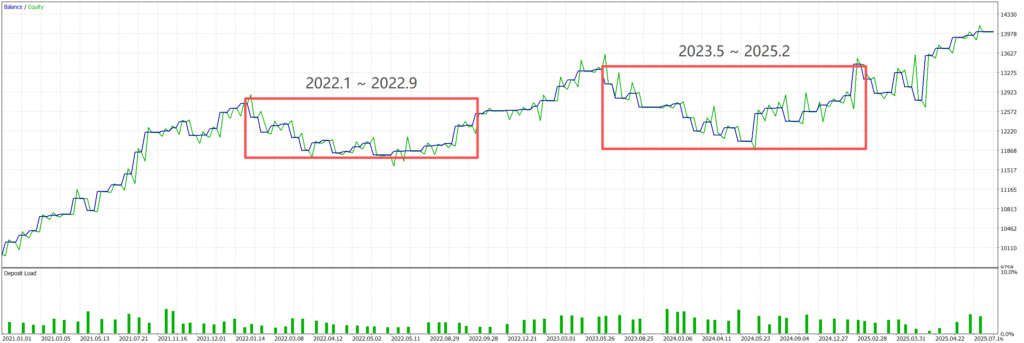
Would you trade the strategy? Probably not, because it is not perfect either. What would you do then? You would likely keep searching for a curve that looks perfect and makes you comfortable. One day, you finally find the Holy Grail in Trading!
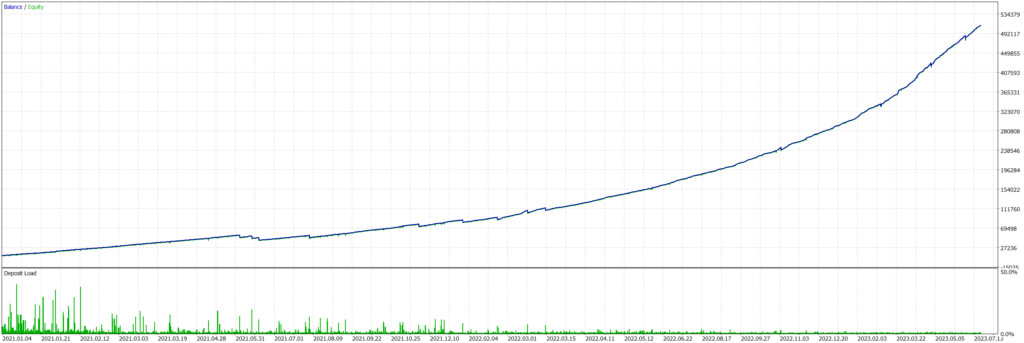
Wow! Look at it! This is your dream strategy! If you had invested $10,000 on January 1, 2021, you would have $500,000 by May 2023 and $100 million by 2025! The curve looks perfect, with almost no drawdowns, and the win rate is nearly 80%!
Wait a second. High win rates, no drawdowns… Why does it sound so familiar?
This is exactly the grid trading strategy, which I developed for months, that blew up my account.
However, as you look at the curve, you still feel tempted because it looks so beautiful, so attractive, so exciting. You have forgotten that this strategy is none other than the one I spent six months coding with 3,000 lines that blew up three times in a single month.
I bet that even after I spell it out so clearly, some people would still want to buy the source code from me. Now do you understand how the peddlers make money from you?
I know you’re still unwilling to give up, still wanting to try, but I’ve been there, and you have to trust me. I was the one who developed this strategy. I knew every line of code, and I made all sorts of improvements, but it was useless. Eventually, I surrendered. I realized I could not break the laws of economics, no matter how perfect it looked.
The reason the backtest curve looks so beautiful is that backtesting is never the same as real trading. There is no slippage in backtests, and every order executes perfectly, but that is impossible in reality. I learned this the hard way, losing $30,000 because I refused to accept the reality.
You must be desperate when you realize the perfect curve was nothing but a dream. You had tried countless strategies, and none of them worked. Either the drawdowns were too big, or the stagnation was too long. Finally, you found a perfect curve that looks like it can make you rich overnight, but it is just another high-risk grid strategy. However, you still don’t want to give up, because the curve looks so beautiful. Once again, you become the Thanksgiving turkey, enjoying your dream of “steady profits” every day until the inevitable blow-up shatters the illusion.
You may feel crushed and want to quit trading because no strategy meets your expectations.
But wait, you are making another mistake by trying to find the so-called “Holy Grail,” which means a perfect system that makes money in every market condition without ever losing. People believe that they will be unbeatable in the market and achieve financial freedom if they have the Holy Grail, so they spend countless nights searching for patterns in candlestick charts, studying books full of mysterious indicators, or paying much money for so-called “secret methods.” This is why people like to talk about Gann’s astrology with great enthusiasm.
If you have done this, don’t be embarrassed. I was once one of them too. Almost every beginner dreams of the Holy Grail; so did I. I truly believed there must be a special method that could turn me from a loser into a market wizard overnight. Every time I saw someone online claiming to have a “90% win rate secret strategy,” my heart would race, thinking I had finally found a secret weapon. After spending tens of thousands of dollars on them, I had to face the brutal truth:
The Holy Grail does not exist.
The market is constantly changing. What works today may fail tomorrow, so you cannot expect to draw a permanent channel to success. If there really were such a path, it would be overcrowded, and there would be no room left for you. If a strategy really worked, it would be all over the internet within three weeks. Tens of thousands of traders would rush in and use it, which would make the strategy stop working right away.
If you are still chasing the Holy Grail, you are wasting your time. If you have done so in the past (which you probably have), don’t worry, it is normal. The important thing is to wake up and accept the reality:
The Holy Grail does not exist.
But now, let me give you some good news:
The Holy Grail does exist!
The image below shows a portfolio made of ten different strategies, each with a correlation coefficient below 0.3, which means each strategy operates independently of the others. When I run ten different strategies at the same time, they complement one another. When one strategy works poorly, another may do well. As a result, the equity curve becomes as smooth and attractive as that of a grid strategy, but it is not as risky. This portfolio generated profits almost every year from 2003 to 2025. Even during 2023–2024, the equity curve did not decline but only stagnated. There was not a single losing year in the past 22 years. It made steady profits every year.
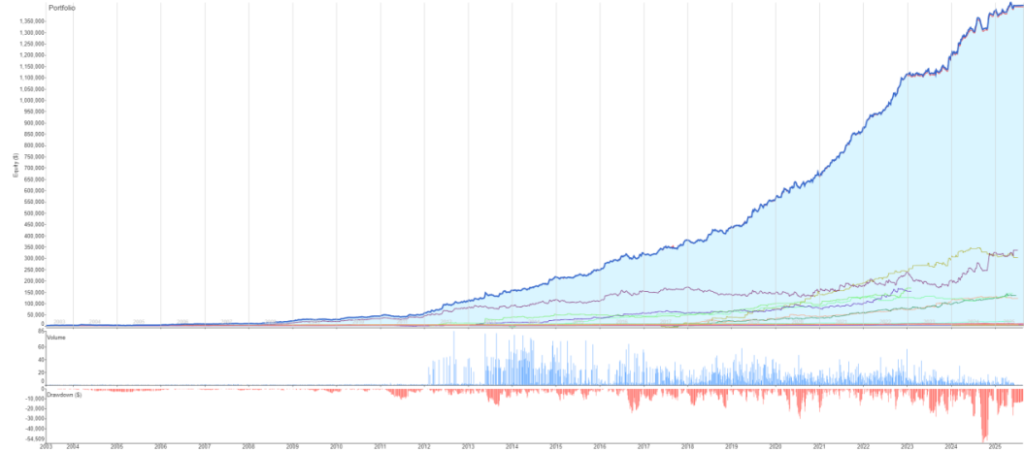
Most importantly, it won’t blow up because every single trade has a strict stop-loss. This is what differs from the grid and Martingale strategies. The strategy will exit a wrong position to protect my money. Each individual strategy looks bumpy, but when I put ten of them together as a portfolio, the curve becomes smooth.
Do you get it? This is the real Holy Grail.
You will never find a perfect system, but you can pick several uncorrelated systems and combine them into a portfolio. The AI has already generated a pile of bumpy strategies for you, and you may have thrown them all into the recycle bin in disappointment. You did not realize that they are fragments of the Holy Grail. Once you put them together, the true Holy Grail appears!
It’s like a sports team. You cannot expect to win all championships with a single superstar. Real champions rely on teamwork and mutual support among players. There’s no perfect individual, but there can be a near-perfect dream team. Likewise, there’s no perfect trading system, but combining imperfect strategies can create a near-perfect Holy Grail. If someone spends his entire life looking for just one great player to win the World Cup, you would think he was mad. What he should do is find several promising players and build a team, and he may win the World Cup even without Lionel Messi.
A trend-following system works great in trending markets but keeps hitting stop-losses in sideways ones, while a range-trading system does the opposite. Neither is perfect alone, but together they complement each other and smooth the equity curve.
The biggest secret of building the Holy Grail is that the systems must be low-correlated. If you pick ten semiconductor stocks, you will not get diversification. Your portfolio will suffer from a bigger drawdown when the semiconductor industry takes a downturn, but if your stocks are from different sectors, the diversification is better.
The easiest way to diversify is to invest in different types of assets. For example, you can pick two stock indexes (Nasdaq, DAX), two currencies (EURUSD, USDJPY), two commodities (oil, gold), and two cryptocurrencies (Bitcoin, Ethereum). When a black swan event strikes, some markets may fall, but others will rise and compensate.
How many strategies do you need for diversification? There is no definitive answer. My portfolio uses more than thirty strategies, and I am still adding more. You can get an almost perfectly smooth upward curve with a hundred low-correlated strategies running together. However, you can start trading with just five or six different strategies.
Maybe you are not familiar with different asset classes yet. Maybe you have only traded stocks and not futures, or maybe you don’t know how to trade forex or crypto. Don’t worry, I will explain all of this in this book.
A few years ago, I would not have been able to write this book, because building one strategy required strong programming skills. Today, AI makes it easier than ever. In the past, it took a lot of time to code, debug, and backtest just to get one system that worked. All you have to do now is explain your ideas clearly to the AI, and it will then write the code.
Exciting, isn’t it?
But don’t rush. You need to know three things before you can get your dream team:
- What elements make up a trading system? You don’t need to build the car yourself. Just hand the blueprint to AI, and it will assemble the car for you. However, you still need to know the basic parts of a car; otherwise, how can you draw the blueprint?
- How to make AI generate usable code? How do you know that what AI writes will actually run if you’ve never worked with source code before? And what if there are bugs? How do you fix them?
- How to set up an automated trading system? You have to deploy the code to the right platform, set it up, and turn it on before it will run automatically.
I will talk about that.
Summaries:
- Most people are going in the wrong direction by looking for a perfect trading system that doesn’t exist.
- Be careful if a backtest equity curve looks too perfect; it is probably a high-risk grid strategy, and in live trading you will be the Thanksgiving turkey. However, If a backtest curve looks bumpy, it means that the system isn’t overfitting.
- The Holy Grail does exist—it is a portfolio of multiple low-correlation strategies. Those bumpy strategies are fragments of the Holy Grail. Once you put them together, the true Holy Grail emerges.
Previous Article: The Myth of Technical Indicators: Do Technical Indicators Really Work?
Next Article: How to Build Your Own Trading System: Entry Rules