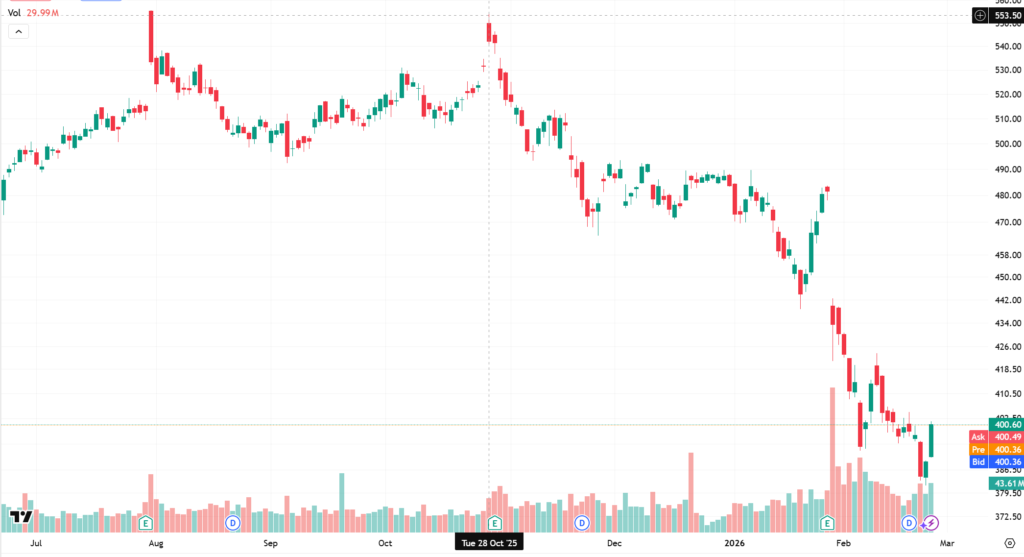
Microsoft’s stock has sharply declined from $553.72 since October 2025, experiencing a 30% drop. Some believe this presents a buying opportunity, while others caution that it may be a trap.
How Much Should Microsoft’s Stock Be Worth?
Can we buy Microsoft’s stock now?
Instead of making assumptions, I will evaluate Microsoft using a DCF model in this article.
1. Zero-Growth Assumption
Microsoft is now worth $2.94 trillion. Will it be able to keep growing in the future? Of course. Technology is moving forward, and the US is a place of innovation. Microsoft could get even bigger.
The most conservative prediction is that Microsoft will grow 0% in the future. Microsoft is obviously not a zero-growth company. The elephant is still dancing. Its cloud business and AI products remain highly dynamic, and the company is also innovative.
I cannot confidently project its future growth. Microsoft is too large, with too many products and sectors to estimate with precision. So instead of guessing its growth rate, I prefer to calculate its valuation under a zero growth assumption. If the stock price approaches that level, I can buy with confidence, because a price with a zero-growth assumption is too cheap, and even the slightest growth would become a bonus.
According to its 2025 annual report, Microsoft generated $136.162 billion in CFO (Cash Flow from Operating Activities). Its CAPEX (capital expenditures) was $64.551 billion.
So the FCF (Free Cash Flow) is
136.162 − 64.551 = $71.611 billion.
I will use the perpetuity model, assuming a discount rate of 8%, so the value of Microsoft is
71.611 / 8% = $895.138 billion.
That means the stock price is $120.54.
2. Conservative Growth Assumption
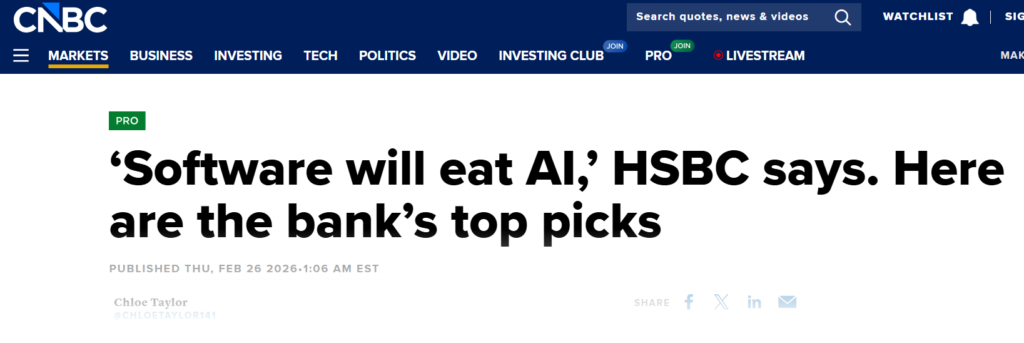
Obviously, $120.54 is far too conservative. It is hard to imagine Microsoft falling to that level. This is Microsoft after all. Its value is widely recognized. When the stock experienced a sharp pullback, many people and institutions, including HSBC, stepped in to reassure the market and discourage panic.
And Jensen Huang.
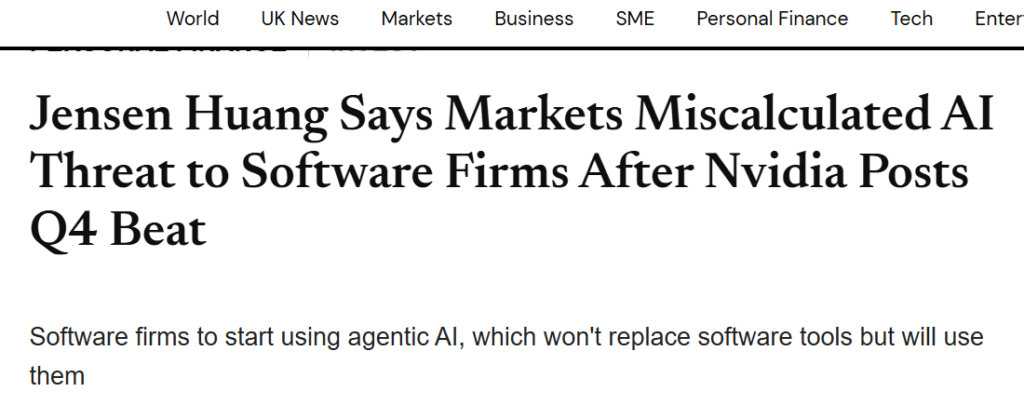
So yes, Microsoft will grow. The question is, by how much?
As I said, I cannot precisely forecast its earnings growth, but I can make a very conservative assumption. At the very least, it should be able to outpace inflation.
Long-term US inflation has averaged around 3%. Even if Microsoft’s sales volume does not increase, it can still drive growth through price increases, thanks to its strong competitive moat. You are probably reading my article on a Windows PC right now. This could reasonably support at least 4% annual growth.
So let us adjust the perpetuity formula to include a growth rate:
FCF / (discount rate − perpetual growth rate)
= 71.611 / (8% − 4%)
= 71.611 / 4%
= $1,790.275 billion
That means the stock price will be approximately $241.08 per share.
3. Reasonable Assumption
$241.08 looks much more realistic, and it is not that difficult to achieve.
However, at the moment I am writing this, Microsoft is still $400 per share. Even after the recent AI panic, the market has not priced Microsoft as a company that will merely outpace inflation.
Come on, this is Microsoft. How could anyone believe its future growth will be just keeping up with inflation?
The growth rate (YOY) of CFO has been volatile, but it has generally stayed within the 20%-30% range. The YOY was 21.8% in 2024 and 15.54% in 2025. Given the ongoing demand driven by AI, it is reasonable to assume that Microsoft’s CFO may sustain an annual growth rate of approximately 20% in the future.
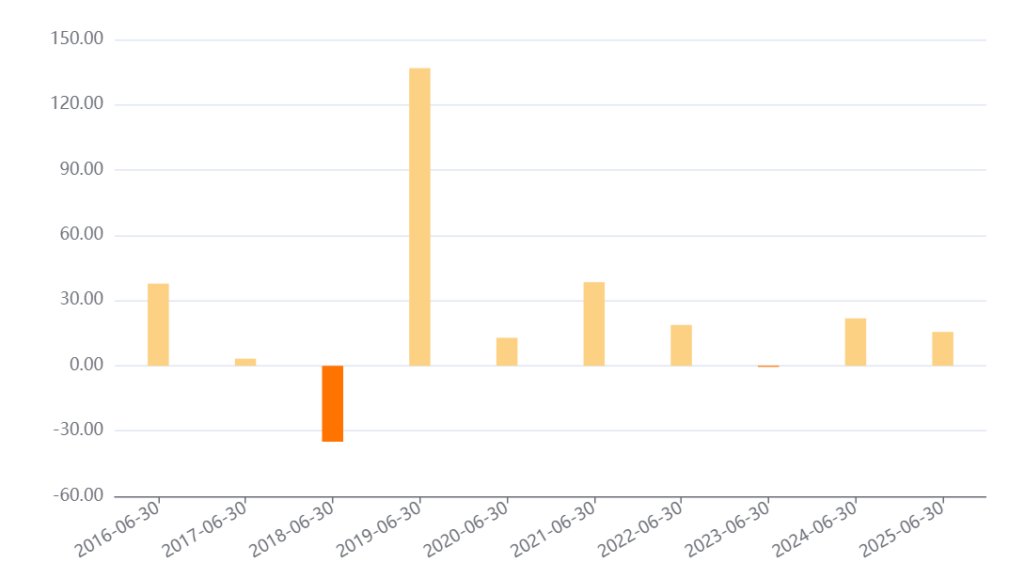
Due to the AI computing power, the YOY of CAPEX is growing faster.
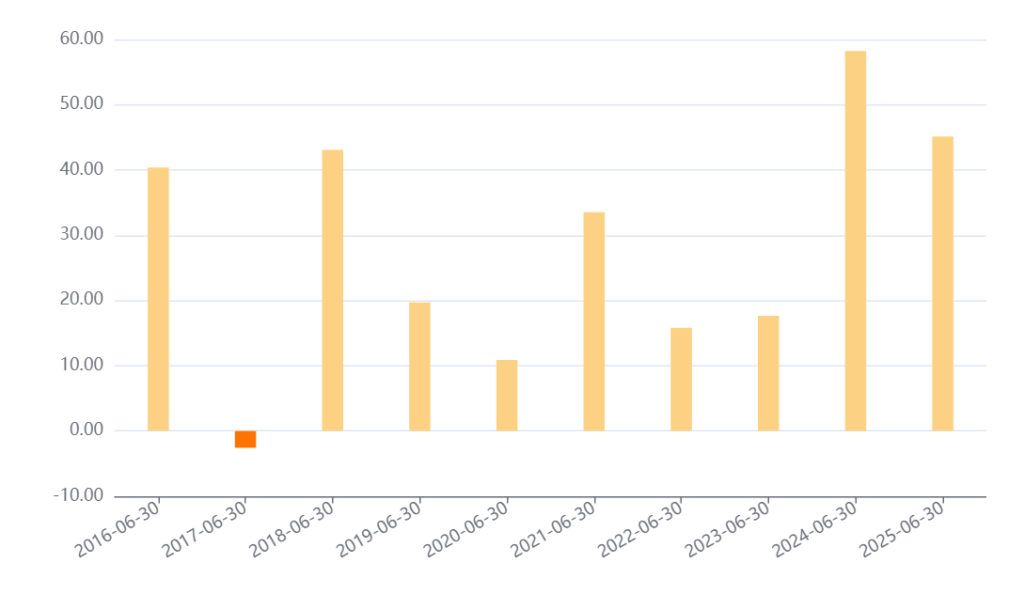
Because of heavy investment in computing power, Microsoft’s CAPEX has been growing even faster. This is exactly what makes tech stocks hard to forecast.
There are three scenarios:
- Optimistic case: The massive investment finally pays off. At some point, Microsoft no longer needs to keep expanding capex at such a high pace. The computing infrastructure begins to generate revenue, and free cash flow accelerates.
- Neutral case: AI returns are not as strong as expected. Microsoft still makes money, but cash flow growth merely keeps pace with rising capital expenditures. After all, the company remains profitable.
- Pessimistic case: The heavy capital spending fails to generate adequate returns, and future cash flows deteriorate.
Let me start with a neutral case assumption.
Over the past ten years, Microsoft’s average growth rate of FCF is about 13%.

Assume it can maintain that growth rate for the next five years.
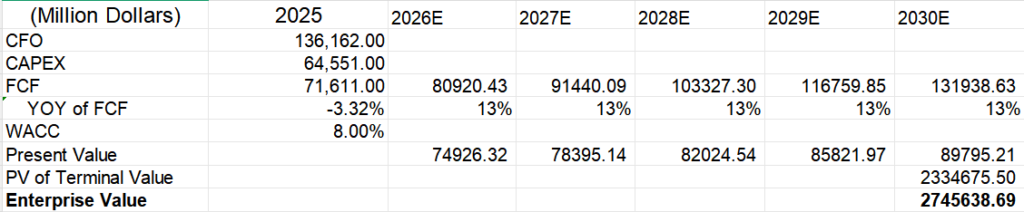
The enterprise value will be $2.75 trillion, which means $369.73 per share.
Microsoft’s share price is in the $380 to $400 range. Even after this pullback, the stock is not particularly cheap. The market still seems to believe that Microsoft can maintain its historical average growth rate (13%~15%). The current price looks reasonable, though not deeply discounted.
“It’s far better to buy a wonderful company at a fair price than a fair company at a wonderful price.” said Charlie Munger.
Do you believe Microsoft is a wonderful company? And is this a price you are willing to pay?
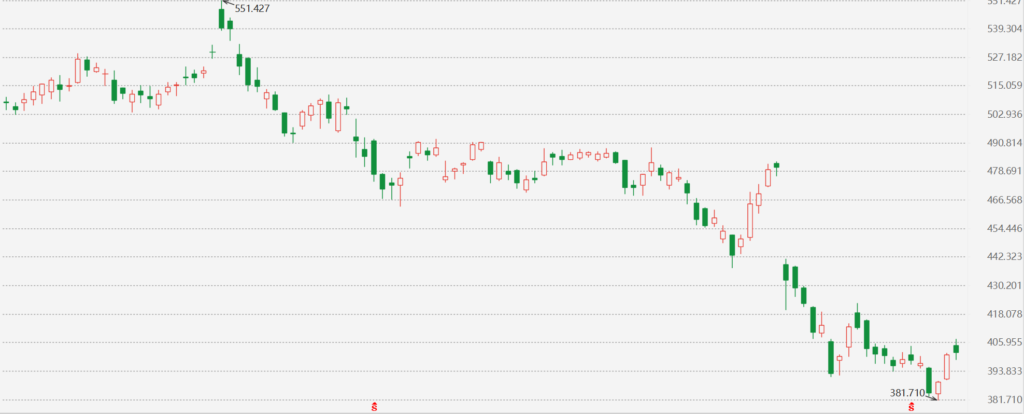
4. What’s Your Assumption?
The valuation model above is based on my assumptions. You may have different expectations. For example, I assumed a 13% growth rate over the next five years. You might think it should be higher (or lower). You can download the spreadsheet and adjust the inputs yourself.
For example, if you change the YOY of FCF to 15%, the price will be more than $400 per share. Now Microsoft seems to be underestimated.
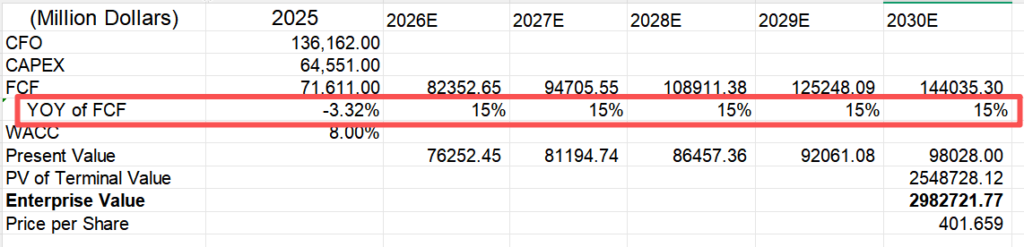
But remember: it is better to be roughly right than precisely wrong.
In my view, whether the model gives you $360 or $380, they are essentially pointing to the same conclusion.