The Strait of Hormuz is closed yet again!
No one even knows how many times this has happened: open, close, close, open. The market has long grown numb, quietly watching the performance between the U.S. and Iran.
Still, some curious people always ask:
- Is the Strait of Hormuz really that important?
- Whose throat does it actually choke?
Many people’s understanding of the Strait of Hormuz still stops at it being an “oil transportation route,” but it’s far more than that. It also determines the transport chains of various bulk commodities, including naphtha, methanol, fertilizers, aluminum, helium, and more. Once the Strait is blocked, it’s not just about rising oil prices, and major industries like semiconductors and new energy will also be affected.
1. Helium
Among all elements, helium has the lowest boiling point, as low as -269°C. This property makes helium almost irreplaceable in modern industrial systems. For example, in semiconductor manufacturing, helium plays a crucial role in chip cooling, leak detection, and high-precision processes.
Although the United States is the world’s largest helium producer, Qatar contributes about one-third of global capacity. Qatar’s helium is mainly exported by sea, heavily relying on the Strait of Hormuz.
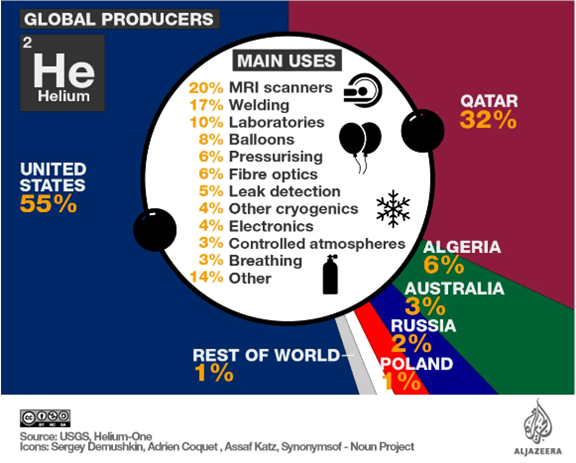
Due to its chemical properties, helium cannot be stored long-term, so countries do not maintain so-called “strategic helium reserves” and must rely on the stability of the global supply chain. Even though the U.S. is a major producer, about 28% of its supply still depends on imports from Qatar, not to mention resource-scarce countries like South Korea (65%) and Japan (33%). Therefore, Qatar’s helium supply is critical to the global semiconductor industry.
During U.S.-Iran tensions, major media have reported on helium supply risks, but the market has focused on oil, unaware that a larger crisis may be looming.
2. Fertilizers
“Food is the first necessity of the people.” This holds true everywhere.
In 2025, the Gulf region exported 46.58 million tons of fertilizers and raw materials, over 90% of which passed through the Strait of Hormuz. Urea, DAP, ammonia, and sulfur accounted for 35%, 26%, 24%, and 47% of global exports, respectively.
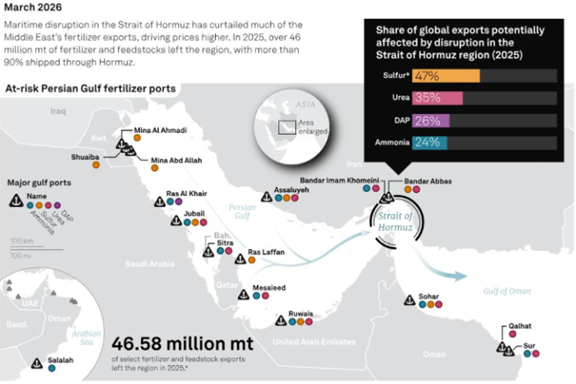
Because agriculture is time-sensitive, fertilizer demand is highly concentrated. Unlike industrial production, where output can be ramped up later to make up for shortages, farming has strict seasons. Anyone familiar with agriculture knows that planting must happen in spring. Once the season passes, even if fertilizer arrives later, it’s useless; crops simply won’t grow in winter.
Unfortunately, this round of conflict coincides with planting season. In the Northern Hemisphere, major countries plant between March and May; India, around June to July; and the Southern Hemisphere, from September to November.
Thanks to advances in agricultural technology, modern society is unlikely to face famine, but rising food prices are inevitable. Since food is a rigid expense, this will squeeze consumption in other sectors, leading to weak global demand.
3. Naphtha and Methanol
Naphtha is refined from crude oil and is used to produce various basic materials such as polyethylene, polypropylene, and rubber. It is widely applied in automobiles, healthcare, home appliances, aerospace, and more.
Asia is the largest consumer market for naphtha. Japan and South Korea rely on imports for 60% and 45% of their supply, respectively, with most coming from the Middle East. Even China, with a more complete industrial system, depends on the Middle East for about 40% of its naphtha imports.
Unfortunately, 60% of these imports must pass through the Strait of Hormuz.
Methanol is similar to naphtha but derived from natural gas. About 35% of global methanol trade must pass through the Strait.
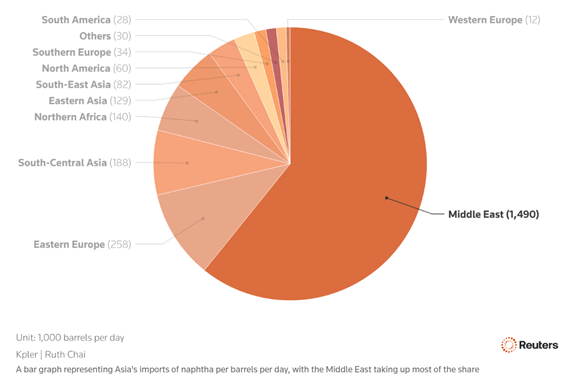
Due to the closure of the Strait, major Asian chemical companies have already reduced the operating rates of ethylene cracking units. Simply put, chemical production facilities are being shut down, and all of this will impact global manufacturing.
4. Impact of Damage to the Global Supply Chain
Although the latest PPI and CPI data are lower than expected, suggesting inflation pressure is not as severe as the market feared, another perspective is that inflation has not yet been transmitted through the supply chain into the data, but it’s only a matter of time.
The “Big Beautiful Bill” tax refunds are seen as a major boost to U.S. consumer markets in 2026, but this benefit has already been offset by inflation. According to the latest IRS data, U.S. personal tax refunds are $350 higher than the same period last year. However, over the past month, U.S. gasoline prices have risen from $3 to $4 per gallon. Even if they fall back to $3.50, an average American household will still pay an additional $560 annually for fuel.
From the production side, this shock will trigger deeper global reflection on “supply chain security” and may reshape the geopolitical landscape of major industries.
Take energy as an example: repeated “chokepoint” pressure from Iran and recurring inflation threats will inevitably push countries to increase investment in new energy sources such as solar, wind, and nuclear power. The world will further recognize the importance of energy security, with traditional fossil fuels serving more as strategic reserves or backup options. Even when fossil fuels are needed, reliance on a single supply channel will diminish, shifting instead to alternative sources such as West Africa, the Americas, and Russia. The currencies and assets of these regions may strengthen as a result.
In industrial production, global chemical giants may seek new technological pathways instead of simply relying on naphtha and methanol. Prices of some alternative bulk commodities may rise after the conflict.
In short, every crisis breeds opportunities. If you can seize them, your fate may change along with them.